I’ve written several blogs on digital marketing concepts, topics, and tools used in the professional industry and how they can be leveraged to help businesses reach their marketing and overall business goals. All which can be found below. Additionally, the blogs are on my LinkedIn profile which you can view by clicking on the title of any blog post on this page.
Changing the Life of Youth One Stride at a Time

Unsplash.com
Author: Evan Cloutier
In addition to being an aspiring marketer, a passion of mine that I participate in and care about is ice hockey. There’s something special about battling with your teammates to achieve victories and even losses sometimes. The sport has given and taught me so many valuable skills and taught me so much about life on and off the ice.
Today’s blog will be focusing on digital activism and social marketing in the world of ice hockey and what I think is a awesome non-profit organization and what they’re doing to benefit society.
HEROS Hockey
The up and coming non-profit organization, HEROS Hockey with twenty-nine hockey programs in eleven cities across various providences in Canada is seeking to make large strides (no pun intended) in the sport of hockey and getting more youth involved in the sport, especially in enforcing the message that hockey is for everyone and anyone who wants to try the sport. On their website they say:
“Hockey Education Reaching Out Society (HEROS) is a volunteer driven charity that teaches life skills and empowers marginalized youth through hockey. We provide free programs to youth of all backgrounds from grade four through post-secondary.”
— HEROS Hockey
I spent time looking at their website, they offer four various types of programs to help get the next generation of youth of many backgrounds with different life stories engaged in the sport of hockey and building connections with others, inner-strength, as well as learn valuable life lessons to help prepare these young beauties for life. Two programs focus on various age groups, one focuses on those who have challenges physically and mentally, and the fourth is an international camp to connect with others over hockey at a large scale.
I love this organization, their idea, as well as their mission. Like I said before, this sport has given me so much and I feel it has played a huge part in shaping who I am today. I agree with the organization and what they say hockey does for youth. It teaches humility, work ethic, teamwork, and achieving something larger than yourselves with your family. Their idea that hockey is for anyone and that anyone can and should play it if they want to, needs to be preached. It has the potential to inspire youth and help them find a passion while building character. What’s not to love about that!?
Examples of Digital Marketing Efforts
Some examples of digital marketing efforts employed by HEROS Hockey are UX/ UI design, inbound marketing, as well as content marketing through leveraging various social media platforms to engage their audience.

For example, their website is easy to navigate, not too cluttered, and has their call to action placed at the top right of the page, a little bit lower in the webpage, and at the bottom of the page. Additionally the page has a good use of white space to break up the copy and images enabling it to be visually appealing and not make the user feel overwhelmed. On top of that, they have their brand color (red) in various appropriate locations on the webpage, which helps give the webpage some character and color which adds to the visual appeal and feel emoted from the website. Lastly, by having a good UX and UI design, they come across as professional, and consumer perception of one’s brand plays a large role in a company’s success or failure.
HEROS’ inbound marketing and content marketing consists of them leveraging their social media platforms to help spread their message as well as direct users to their website. On each of their various social platforms (Facebook, Instagram, Twitter, and YouTube) they have a hyperlink placed to directly guide traffic to their HEROS Hockey webpage. Their posts allow for interaction, discussion, show the youth players they’ve helped through hockey, as well as let the organization show what they’re up to, to create hype and buzz among their audience. Additionally they have earned media from Canada’s SportsNet in the form of a blog article on the website praising the work the non-profit organization does. Additionally in the earned media from SportsNet, HEROS got a earned link on the blog which will direct users directly to HEROS Hockey’s homepage on their website. HEROS also attained placement on Skate To Great’s website. On Skate To Great’s page, they have a list of non-profit hockey organizations that an individual can choose to support or possibly seek knowledge about for enrolling one’s kid in the organization or program, like HEROS Hockey for example.
How Would I Use my Marketing Knowledge to Support this Cause?
To support this cause, I would employ content marketing to further create a conversation around the organization and their cause. By doing so, I would create valuable content for the consumers viewing messages from the brand. For example, I could use YouTube to create a beginners video to hockey to explain concepts, gear sizing, or create videos from the ice sessions showcasing and highlighting what they do. On top of that, I would write blogs (with a link back to their website) regarding their organization, what they do, my opinion, other’s opinions, etc. to promote the business to those who read my blogs. Through this earned media, they would garner an increase in traffic, as well as potentially help their S.E.O. efforts and rank higher in search engine result pages.
Additionally, through building and creating sponsorship opportunities for other businesses to come and sponsor the organization and the cause in general. First, it would help the organization be able to provide a better experience for those attending these hockey programs. For example, funds from sponsors could help with gear procurement, buying more ice sessions, and so on. In the marketing sense, by pairing with brands that are popular among many consumers, or have positive brand perceptions would align the brand image with corresponding sponsors and effect consumer perceptions positively. This could lead to more enrollment in programs such as HEROS through an increase in donations due to creating positive perceptions and favorable attitudes towards the brand. From here, utilizing social media platforms and other digital channels, I would post and create content about upcoming events with sponsors, create discussions with followers to create buzz, conduct e-mail marketing to reach those who have donated previously and communicate with them about upcoming events and ways to get involved, as well as create additional content like I mentioned above such as blogs, YouTube videos, or short highlight reals for platforms such as Instagram featuring programs like HEROS highlighting the joy of new or returning players stepping on the ice and playing a game like no other. Short reals such as the youth hockey players on the ice could elicit emotions as viewers see these kids having fun, making connections, and learning new skills leading to consumer validation and keep those consumers coming back and donating.
In summary, HEROS Hockey and a multitude of other non-profit organizations are seeking to broaden the accessibility of hockey to everyone and are seeking to change and empower the next and upcoming generations through the sport. Through the utilization of digital marketing efforts, digital activism can reach multitudes of new consumers you may have otherwise not reached. This awareness could then lead to them seeking knowledge about your organization through various social platforms, your website, and other content you’ve created or that others have created about you.
Search Engine Optimization: Pretty Different From Scrabble

Author: Evan Cloutier
Search Engine Optimization (S.E.O.) and link building are fundamental facets of organic media that drive traffic to your business’s website. Through investing time, work, and effort into S.E.O. and link building, your business can climb search engine’s rankings and appear at the top of user’s Search Engine Result Page (SERPs). I’ll explain how in this blog.
What is S.E.O?
Search engine optimization is the process of engaging in activities such as keyword research (which aims at uncovering your keyword’s volume/ difficulty in search results, increasing your search ranking relative to other companies, other relevant words related to your industry that appear in search results, and users search intent) and link building (earning external links to your webpage or product page through product reviews, influencer’s social medias, blogs, etc.) which in turn will increase traffic to your site through the strong and unique content you have waiting for incoming users.
So why do businesses practice and engage in search engine optimization?
A few reasons are:
- It can help increase your business’s search engine result page (SERPs) ranking. If your page is placed higher at the top of the SERP, the higher the likelihood a user clicks on it because your page came back as a top result for their search.
- Businesses additionally perform SEO to understand how users search for their products and services and can seek to create enhanced search experiences for the user through unique and original content
- Businesses conduct link building which is a part of search engine optimization, by having relevant and quality content that triggers external sites to link your page to their post, blog, etc. This can lead to new traffic as well as cause other users to trust you as an expert and authority in your field… Ultimately helping search engine rankings.
S.E.O. works through bots or crawlers, which go through links associated with your page, your content, and URL and additional links to find new webpages on the internet. Next, these newly crawled (found) webpages go through a process called indexing where in which the search engine scores your webpage across various criteria to determine your ranking. Here, you must make sure your content that you’re trying to increase traffic for is popular, public, unique, and known. In the ranking stage, search engines display pages based on relevancy and ability to answer the searcher’s question paired with the their intent.
What is Link Building?
Link building is the activity or process of obtaining links placed on external sites that navigate back to your business’s webpage. In addition to organic searches, link building is a crucial aspect of organic social media. This is because links act as a directing point for attracting new traffic to your website. Link building comes from having quality content on your website or from creating quality content about your product in forms such as a blog. The key aspect here is quality content, if bloggers, hyper influencers, etc. come across your content and like it in some way shape or form, or it adds value for them, they could write a review or speak about your blog and link it in their own posts. This would allow for relevant audiences who are potentially interested in your product or service being offered to follow that earned link back to your site. If done correctly, this allows for an increase in traffic as well as obtaining more earned links which will signify you’re an expert and authority in your industry, as well as are knowledgeable and trustworthy about what you’re content is speaking on.
You may be asking why do businesses put time, effort, and money into link building? That’s because:
- Link building can increase traffic to your site through earned links which can increase brand awareness and visibility thus hopefully translating into future conversions.
- Link building can positively shape perceptions of consumers as, if you are linked by high quality and well respected bloggers or news sources, this can cause consumers to perceive your brand as being an expert, trustworthy, and an authority in your industry.
- One of the most important reasons to engage in link building is because it works in synergy with S.E.O. in the fact that, by earning more inbound links to your businesses webpage, Googles crawlers will crawl those links as ways to navigate back to your page, which is one of the many criteria Google looks at when ranking pages in its search engine.
The main take-aways for link building are that, its crucial to perform if you want
- To truly optimize search engine optimization.
- Needed to position yourself as an authority, expert and trustworthy in your industry.
- and lastly can help your search engine rankings and signal to Google that your webpage is the best and most relevant for answering users search questions.
Where is S.E.O. Going?
As time never ceases, a great question to ask is how will S.E.O. be shifted and utilized in the future. A blog written by Kris Jones called The Future SEO: Boardroom Edition on Searchenginewatch.com, highlights and provides many routes S.E.O. may take in the future. Some of the key ideas I identified from reading it were that, the intent of users while performing searches will only increase in importance. This is likely attributed to Google’s search algorithm constantly being refined, updated, and more effective at ranking and delivering high quality and relevant pages for a specific user’s search. Additionally, the blog advises businesses and marketers to create more evergreen content where its relevancy doesn’t diminish overtime and continues to attract web traffic and provide value to users.
Regardless of the future, S.E.O. is crucial to a successful organic media strategy and in attracting traffic and increasing brand visibility through top tier content creation which will hopefully lead to conversions as users engage with your brand and move through the conversion funnel. As for the future, S.E.O. will only increase in importance as new updates to Google’s algorithm arise, and as new innovations in technology are created. S.E.O. and link building should be in the mind of all businesses seeking to be successful in their industry.

Author: Evan Cloutier
Paid search and a business’s overall search engine optimization efforts paired with other digital and traditional marketing efforts will help a business reach goals such as raising brand awareness and visibility, create engagement through email sign ups/ special notifications, drive conversions such as purchases or membership sign ups, or allow for potential consumers to research your brand.
What is Paid Search and Why Should You Care?
Paid search, or Pay-Per-Click (PPC) Advertising is a digital marketing method where your business displays ads on user’s search engine result pages through leveraging search engines such as Google, Yahoo, Bing, Internet Explorer, or Mozilla. Its name, Pay-per-click, provides insight into how it works. After creating your ad, based on your target audience and configuring your settings in which ever ad generator software you’re using for that said target audience, you then select a bid price. This bid price will be the max cost-per-click (CPC), which is what your business pays when a user clicks on, views, and interacts with your ad content. Paid search can be leveraged to create windows of opportunity to communicate and promote your business and the added value of your brand to a highly relevant and engaged target segment. PPC advertising can be used to initiate action on behalf of the consumer such as buying your product or service, or allow for consumers to engage with your brand through performing a search and coming across your business’s ad at the top of the SERPs. From seeing the ad, the consumer could click on the ad and then research your brand, product, or service to gain more knowledge and later make a purchase.
So why should marketers and businesses care about investing in paid search initiatives? Like other S.E.O. tactics, paid search can help nudge consumers through the conversion funnel to take desired actions (whether that’s email signups, purchasing a product, engaging in a subscription trial, etc.) to reach your respective marketing goals. While PPC can increase exposure to your business’s marketing messages and thus increase your brand awareness, PPC advertising is better suited for reaching your target audience members who are further down the conversion funnel and usually have some existing knowledge/ awareness of your brand and what you offer. For example, in one of my previous marketing courses, my team and I completed an analyzation of the shoe and clothing brand Allbirds. While conducting this research, I frequented the site to gain knowledge on the brand. Fast-forward to now, I performed a search for “shoes” and Allbirds’ PPC ads populated my search engine result page.
Below is a screenshot of the mentioned above search I performed:

From this, we can see that Allbirds ranks highly in the competitive world of PPC advertising for the term “shoes.” To rank here, your website and all additional content should be relevant to answering the respective query that would trigger your ad to show as well as have a strong keyword bid for each ad and ad group. Another important thing to note, PPC is easy to measure as well as control. Metrics such as the number of consumers who clicked on your ad, micro- or macro- conversions met, the CPC per ad, as well as revenue streams attributed to your ad can be viewed from software such as Google Ads. PPC campaigns are great ways to compliment your other search engine optimization and marketing efforts as well as your overall paid and owned media efforts to ultimately rank high and trigger ads on user’s search queries.
Google Ads Vs. Bing Ads
Google Ads and Bing Ads are both software platforms that allow you and your business to run paid search campaigns on their respective search engines (Google and Bing). These two ad softwares are very similar in terms of settings to target/ optimize your advertisements for. For example, both Google Ads and Bing Ads allow you to segment your campaign across the following parameters:
- The products or services offered
- Geographic location/ user proximity to business
- The keywords you target and their respective bid prices
- Seasonal nature of your product
Additionally, both services use campaign and ad groups (the grouping of more than one ad and its keywords that are related to each other). This allows for similar products or ads to trigger when a user performs a search query containing your keywords. Thus increasing the likelihood of exposure to your paid marketing message. If you or your business wanted to incorporate Bing Ads into your digital marketing campaign, that not a problem at all. Bing Ads allows for you to import files and existing campaigns from Google Ads into Bing. By doing so, you can optimize your S.E.O efforts (organic, paid, local, and voice search to name a few) across multiple search engines to maximize your efforts. This will ensure that your messages and additional content are consistent across the various search engines being utilized as well as allow for more potential traffic to find their way to your webpage via paid ad.
How Would an MBA Program Utilize PPC?
Before describing how an MBA program could utilize PPC to increase applications and awareness, we need to identify the Target audience of MBAs. Historically these are individuals who have graduated with their under-graduate degrees and have had some time to gain work experience at an entry level position, or who wanted to take some time off for personal reasons before deciding to continue and enroll in a MBA program. In the case of leveraging PPC to increase enrollment and awareness, actions to take include:

- The MBA program needs to perform in-depth keyword research and measure the frequency and volume associated with their existing keywords. This will help ensure that when users perform a query related to a MBA program, yours will be a candidate in the running. For example, geographical keywords such as “PNW, pacific northwest, MBA, Washington, Everett” should all be utilized to attract relevant and qualified users, i.e. those who possibly live in the PNW and are seeking to further their education through a MBA program.
- Additionally, The MBA program could utilize ad extensions, to provide more information and allow users to derive more value from your ads. For example, sitelinks placed in your Ad can allow for users to navigate to specific pages or subpages just from clicking on your ad. Additionally, you could place a call extension giving those viewing your ad the power to directly call a spokesperson for the MBA program to find out more information regarding it, talk about enrollment, or other reasons you’d call the MBA administrative department. You could also place a location extension in the ad allowing for potential applicants to research if there is a partner facility offering the MBA which would allow those not located in close proximity to the “parent campus” to be able to attend. Additionally by featuring an ad with location extensions, this could cause potential applicants to travel to the campus and possibly fall in love with the area. This emotional connection with the area could then cement that this is the place where the potential applicant wishes to further their education and cause the applicant to enroll in the MBA course.
Working with paid search, the MBA program should ensure they have strong organic S.E.O. as well as high quality owned media, which if successful should generate earned media and help give additional coverage and lead to increases in the programs enrollment and awareness.
Creating a Logo: A How to Guide

Author: Evan Cloutier
The process of creating a logo is no clear cut easy task. It requires time (quite a bit of it), patience, creativity, and imagination. I went through several iterations of my logo, whether it was changing the colors, fonts, or scrapping what I had as a whole, I was constantly finding some aspect I wanted to improve until it just clicked and I had a finished logo I liked.
Beginning the Process
When beginning the creation of a new logo, whether you’re using Adobe InDesign, Canva, or some other software or template service, start by drawing rough drafts out on scratch paper until you have a rough idea of what you want your logo to look like. By doing so, you’ll have a better idea of where your logo creation journey is heading. This will make making minor changes easier as you have the big picture snuffed out and can work on adding finishing touches before digitally designing and creating the logo.
Also important to note, while marketing is consumer-centric, construct your logo based off who you are, your values, things you identify with, and more. For example, My logo utilizes shades of blue to reflect loyalty, trust, calmness, and peace which are all things I care about and value but also want to communicate about myself to potential clients.
The cool but challenging part about something like creating a logo is that there aren’t defined answers about being right or wrong. It’s about creating an extension of yourself to communicate your brand visually to consumers through brand elements.
Below are two pictures of different drafts of my logo side-by-side (the image on the top was my first logo I created and the second image is my current logo).


As you can see, my first logo and current logo are drastically different but still have some similar aspects. For example, the shape is still a circle, still about me, both are still relevant and represent me but communicate and represent me in different ways. The purple in the first logo is a mix between red and blue communicating a balance of excitement and relaxation which I feel represents me. However I just felt the different shades of blue represented me more truly and the type of message I want to send. Additionally the gradient circle represents the problem marketers are trying to solve. I incorporated the gradient logo because yes I liked it but also because to get to the core of the problem we can only identify it through asking questions, performing research, and utilizing data. The point I’m trying to make is that to understand consumer’s problems we have to look past the “surface.”
Designing and Finishing Your Logo
Once you’re ready to digitally create and design your logo, utilize software such as Adobe InDesign or Canva like I mentioned earlier. There are tons of content and how to guides in the form of videos and blogs to help navigate and use the design software which will make the process less stressful.
Like mentioned above there is no write or wrong answer to logo design, just keep editing the logo until you’re satisfied and ready to put in on your social media channels, your website, or where ever else you may be putting your logo.
Creating a finalized logo that I was proud of and that is relevant to me took me roughly a month. This is because I made small iterative changes to my logo over time to ensure I was creating something that communicated myself and my brand. The process to creating a logo was no easy feat and took a lot of time to create. However, the feeling of having a brand logo far outweighs the stress and time it takes to create it.
Another benefit of logo creation, is that through creating it, you identify your brand colors, fonts, and tagline which are crucial to branding yourself as an individual and allow for recall and association to be formed in the mind of consumers upon exposure to your logo.
In closing, logo creation and branding yourself is a difficult and time consuming task, but putting in the time is worth it when the benefits can be monumental.
My Five Largest Dos & Don’ts of Integrated Marketing Communications (IMC)

Author: Evan Cloutier
There is no easy way to sum up integrated marketing communications (IMC) because it encompasses so much, but if I had to provide a definition I would say IMC is the quick and reactive approach to marketing with emphasis on synergy between your website, various social media channels, various content (blog posts, portfolios, press releases, and other branded content), search engine optimization (S.E.O.), and advertising efforts (organic & paid) to achieve creating a consistent brand image and identity across all the various channels you use to communicate with your audience.
To ensure each communication channel is consistent and has synergy with your other channels and content we’ll look at some of the “dos and don’ts” of IMC.
DO: Create and Design Brand Elements to Incorporate On Your Different Communication Channels and Content.
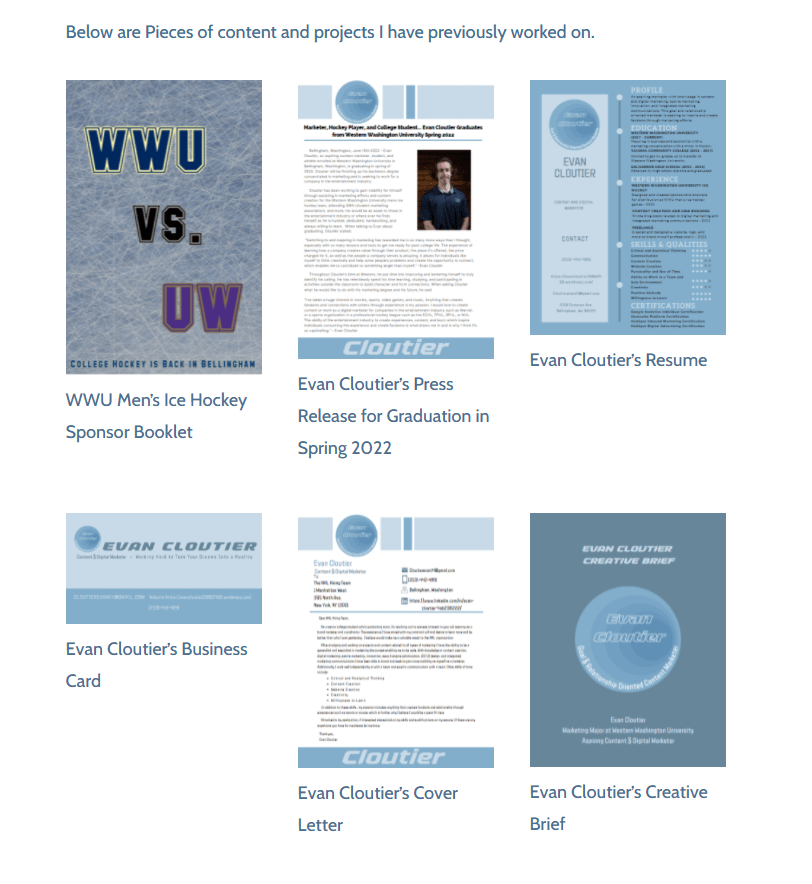
In general, but especially when starting IMC efforts, take some time to create and design a brand logo, utilize and choose colors that communicate what you want your brand to say to consumers and to help visually differentiate you from competition. Additionally, pick fonts that are visually appealing to increase positive perception and recognition. Differentiation that is unique and visually appealing is key.
The image on the right is from my portfolio page on my website. Each piece of content has my logo, brand colors, and brand fonts to be consistent and allow for integration with other channels, deliverables, and content on my site. In addition, I created a professional Instagram account with my logo, colors, and fonts and integrated posts regarding content on my site and other channels to further increase the synergy between channels. Furthermore, I created a branded banner for my LinkedIn profile to further my efforts towards increasing recall, reach, visibility, and awareness.
DON’T: Use Every Social Media Channel
While some businesses utilize a lot of social media platforms to interact and engage with consumers, raise awareness, or influence consumers to click on some call-to-action (CTA), it’s not necessary for you and your brand to be on every social media. What you should do is research your target audience and utilize your existing data on demographics, psychographics, and geographics to identify who your audience is, where they live, their values, behaviors, and media habits to identify which social media platforms they’re on. After that, get your brand on any social media platform your target audience uses and begin your communication efforts. The key take away is that you’re on the platforms you’re target audiences use, not the ones you like, because after all IMC requires a consumer-centric mindset at its core.
DO: Engage in Search Engine Optimization (S.E.O.)
As you’re engaging in IMC efforts, a crucial part is search engine optimization. A large takeaway of IMC is to have consistent channels and integrated posts to create synergy and drive website traffic. However, S.E.O. plays a huge role in earning impressions and ranking high on search engine result pages (SERPs). Perform keyword research to identify what words users are searching for while performing a query related to your industry, their user intent, as well as to identify long-tail keywords that are specific to your brand. After performing keyword research, you should also practice link building and inbound marketing efforts to boost S.E.O. efforts. Link building is acquiring or earning links in external pieces of content owned by others that directs users back to your work via clicking a hyperlink in their work. This can help search engine optimization as Google uses these earned links to signal that you’re credible, can be trusted, and are an authority or expert in your industry and rank you higher in the search engine result page. S.E.O. is crucial to IMC efforts as you want your content whether its a blog, advertisement, website URL, or social media account to show up at the top of the search engine result page.
Don’t: Try and Get It “Right” in One Go
My parents when I was a kid, would always tell me “good things take time and patience.” This is also true with marketing. Content creation is a iterative process that takes time, feedback, and sometimes failure to succeed the next time or time after that. This process adds value as each time improvements are made, or content creation is changed or elevated, the user receives more value than they did before. It also allows for you to get feedback and have discussions with consumers to learn what you’re brand is doing well and what you could improve on.
DO: Create Content

Creating branded content for yourself is crucial to any IMC strategy. It allows you to demonstrate your skills in the field that interests you to gain visibility and potentially create opportunities for job interviews. By creating content and sharing it on your website and then integrating it by including the content on your other branded social media platforms paired with link building, creates the opportunity for others to share your content with the world, creates the opportunity to connect with and be discovered by organizations you want to work for, and creates examples of work that you can show potential employers. Content creation is a great way to increase visibility while providing knowledge or some value out to those viewing your content. For example, I’m seeking to go into content and digital marketing in the entertainment industry and sports industry. To gain experience for this, I created the Western Washington Men’s Ice Hockey team’s sponsor booklets for game night events using Adobe InDesign. These booklets had information and ad space for the sponsors, information on special events at the game, and information on the players. I then put this content on my website so that any potential employers can see what I created and see visual execution of my skills.
Just to mention, while creating content for an organization, you should tailor the content to your target audience and ensure its targeted and relevant to them to encourage the specific conversion you’re seeking to get. Whereas for one’s personal brand you would still create content for your audience, but your audience is the organization you’re trying to obtain an interview with or get attention from. Additionally, each piece of content should seek to assist consumers in specific stages of the conversion funnel (Awareness, Interest, Decision, Action). For example, created content for consumers in the interest phase of the funnel could take the form of blog posts, videos, social media posts, and more to provide knowledge on the brand, product, or service.
An IMC strategy can greatly boost visibility and increase awareness for your brand while communicating to others that you’re an authority in your field through creating consistent branded content, a website with your brand logo, colors, fonts, and other elements, as well as integrating all the social channels you use to include your content, news, and brand elements to create synergy between all those channels, which is an unmatched strategy. If you aren’t embracing or practicing IMC efforts, give it a try, you wont be disappointed.
How to Write a Blog: The Cloutier Approach

Before this fall I had never written a blog before. That all changed when I took digital marketing. The thought of creating content such as written blogs that can be viewed by the world is an intimidating thought, and if you find yourself thinking that, this blog could be for you.
Before Writing a Blog
Before you get into writing a blog you need to do a few things:
- embrace a creative mindset
- Remember not everyone is your audience and some people may not like your content, but don’t get intimidated by that. Only listen to feedback or comments that matter or allow you to improve your content, consumer’s experience with your band, or what you offer in some way.
- Create an Outline
Creating an Outline
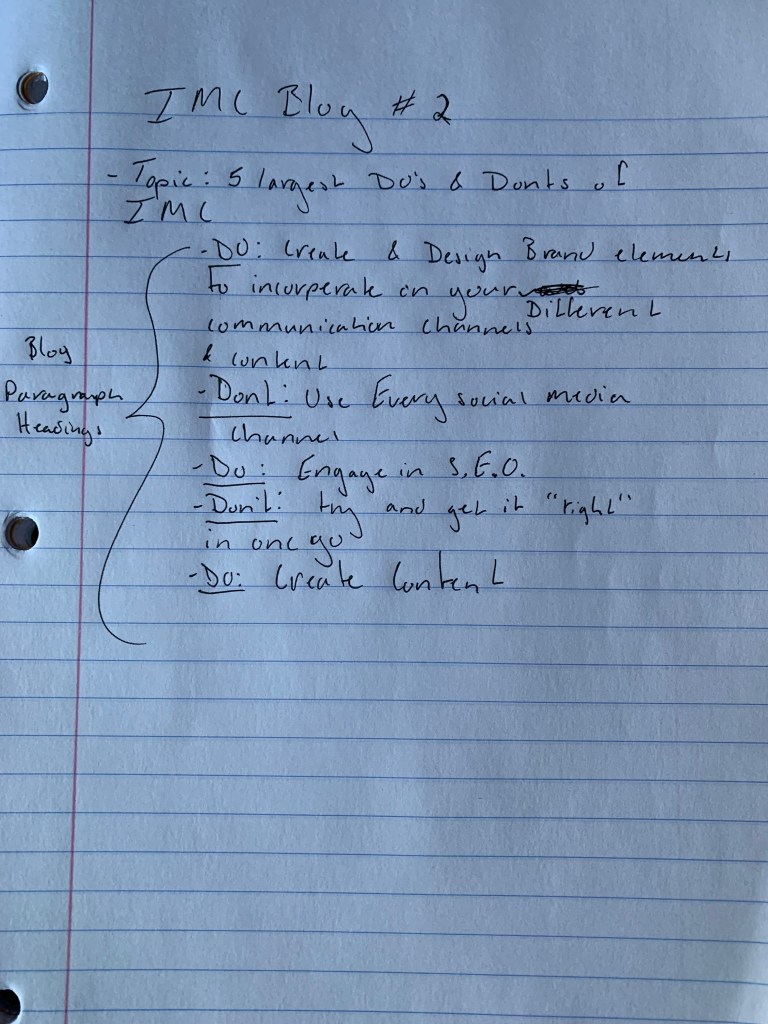
People’s process for writing blogs can be different from person to person, it takes time trying new styles and other’s methods to create and identify your own. For me personally, I start my blogs by writing an outline on paper. For example, the picture on the right is an outline I did for my blog on My Five Largest Dos and Don’ts for IMC. To start, I create the title of my blog. The title should pertain to the topic you want to write about but also provide insight into what the blog will be about. I then list the title at the top of the page and then list the subtopics of what I’m writing about. For example in the picture, my topic is the five dos and don’ts of IMC, and the subtopics are the “DO: Create and design brand elements to incorporate on your communication channels and different content” and so on down that list. These subtopics then become my paragraph headings for my blog. This is where I usually end my outline process, but like I said, everybody is different and may want to continue and go more in depth with their outline and some may not write outlines at all.
After I have my outline complete, I use my notes I’ve taken on the topic and my knowledge on the topic area to write the paragraphs.
Writing the Blog
Like I mentioned above, I use my notes and knowledge about the topics to write my blogs but it doesn’t end there. I begin the process of outlining a week before I post the blog. I do this to give myself time so I’m not stressing about it and to give myself the ability to edit it and change text or other aspects within the blog to create the best content I can. While writing the blog, keep in mind who you’re writing it for. The goal of writing content such as blogs is about adding value whether its providing knowledge, creating awareness through earned links, or convincing an individual that your brand is the “right” brand after reading a blog review on one your products or services… you want your blog to give the viewer something. Additionally while writing the blog, use images and white space (breaks between paragraphs) to make the blog more easy to read for the viewer which will allow the viewer to be more engaged.
One important thing to note, after finishing and uploading a blog to your website, integrate it with your other brand social media platforms. For example, I post the blogs from my website on LinkedIn and post Instagram stories from my branded Instagram account whenever I post new blogs.
The main things to keep in mind while blogging are to keep your target audience in mind while writing, create content that’s relevant to them, listen to the feedback that matters, and keep practicing. Blogging takes time and when I first started I had a hard time writing blogs, just keep at it and practicing and you’ll be writing and creating great content in no time!
 Evan Cloutier